 Digital Commons Help Center
How Can We Help?
Content Collecting Tool: Display Records in Multiple PublicationsContent Collecting Tool: Display Records in Multiple Publications
One Submission, Multiple Collections
Sometimes administrators would like a submission to appear in more than one publication in the repository without uploading and publishing it multiple times. There can be several reasons for this.
- A submission can be equally categorized under more than one department in the institution.
- A submission provides information that is useful in more than one context.
- A submission is part of a larger collection, such as a university-wide ETD collection, that the administrator would like to also showcase in smaller collections, such as department-level ETDs. Larger collections set up for this purpose are often called “bucket” collections.
A dissertation posted to a general ETD series and also collected to the department’s ETD series:
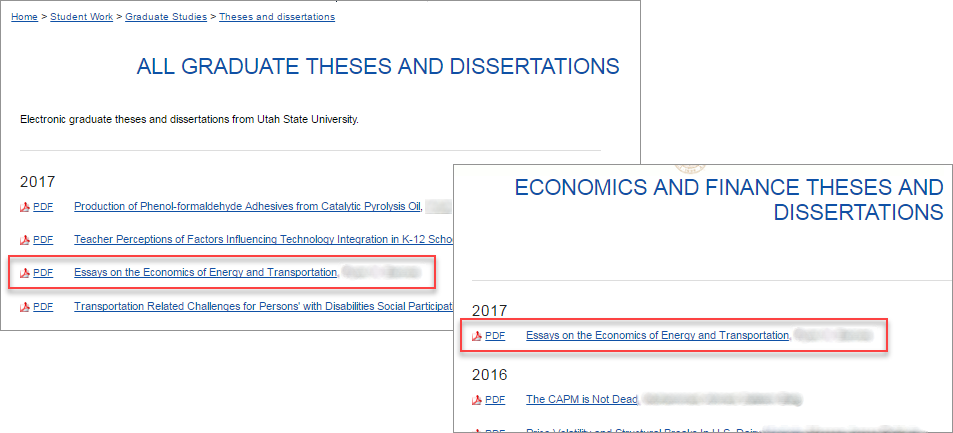
Overview of the Content Collecting Tool
The content collecting tool makes it possible to “collect” an article to other locations besides where it was originally published in the repository. For instance, an article posted to Series A can be included in Series B. The article is added to Series B’s article list, and clicking the article link takes visitors to the original location in Series A. Collecting can also be used between tracks in a conference structure or between issues in a journal.
Collected submissions always retain their original posted URL no matter which location they are collected to, ensuring the consistency and integrity of citations. Download counts are likewise kept unified. Display may vary depending on the destination of collected submissions, particularly if the publication types differ. If you have questions about display, please contact Consulting Services.
There are two ways to collect posted items. Submissions can be manually collected from one publication to another publication one at a time, or administrators can set up filters to ensure matching submissions automatically appear in specified publications.
Manual Collection: Collect Articles One by One
Manual collection can be used to collect published submissions from other publication contexts within the repository.
Administrators should use manual collection when they want to collect only one article or a small number of articles directly into a particular publication.
To manually collect submissions:
- Start on the Configuration screen for the publication where you would like to display collected submissions, and choose Content collecting tool (previously labeled Collection) in the left sidebar.

- Choose Edit in the Manual Collection row.

- Enter the URL of the desired content, one URL per row. Click on a + Add button to add a new URL row.

- Click Save.
- Click Publish saved changes in the Configuration sidebar to make your changes public.
Automatic Collection: Set It and Forget It
Automatic collection uses search parameters to find posted submissions with specific metadata, then display links to those submissions from a desired publication.
Administrators should choose automatic collection when they have published submissions that share common metadata values that they would like to display in multiple collections simultaneously.
To set up an automatic collection filter:
- Start on the Configuration screen for the publication where you would like to add collected submissions, and choose Content collecting tool.
- Choose Create new filter to set up a metadata filter.

- Enter a Filter title if you wish to differentiate it from others you may create. Use Within publication to select a specific structure you would like to collect published submissions from, or leave “All” selected to collect from across the repository.

- Use the + Add and Remove buttons to control the number of filter parameters. Multiple rows will create an AND query, which only returns submissions matching all parameters. (Use multiple filters instead if you'd prefer to collect submissions matching any parameter.)
- Select the field you would like to filter by, such as Title or Abstract.
- Select an operator, such as “is” or “includes”. Operators in the drop-down menu change according to the type of field.
- Enter a value for the field. Some fields allow you to select from a list of values. Fields are not case-sensitive, except for the Document Type field, which requires values to use their back-end field names (e.g., article). Please ask your consultant if you need to confirm the correct document type values for a site or publication.
- Click Save.
- Select Publish saved changes in the sidebar to display any existing submissions that match the filter. When new submissions are identified that match the filter criteria, the publication will add those submissions and display them following an automatic nightly update.
Enhancing Collections with Additional Metadata
Administrators can add metadata to publications at any time to support new collection filters. This can be done on a submission-by-submission basis, or additional metadata can be added using the batch upload and revise function of Digital Commons. When articles are batch uploaded and revised with new metadata, the automatic collection filters will ensure that published submissions appear in the appropriate publications.